
The iPhone Air is a highly-repairable smartphone despite being so thin, the annual teardown of Apple’s latest models reveals.
Shortly after Apple releases a new product, there’s a rush by repair outfits to take apart the latest hardware to check out how its made. For the iPhone Air, the teardown from iFixit reveals more about how Apple rearranged the structure of its smartphone design to match such a thin profile.
An initial Lumafield CT scan before disassembly confirms a big design change to move the important components into the new wide camera bump. The section, which Apple refers to as a “plateau,” is occupied by the logic board and other elements, freeing up the rest of the space for the battery and display.
It’s a clever design, iFixit reckons, since it also protects the iPhone Air from stress if it is flexed in a pocket. This significantly reduces the chance of another “bendgate,” as a YouTuber demonstrated earlier on Saturday.
Battery
After taking out some pentalobe screws by the USB-C port, the back glass was removable as usual with little fuss. It gave an immediate view of the metal-covered battery used by Apple this time.
After removing a bracket to disconnect the flash and microphone assembly flex cable that blocked full rear glass removal, a cowl could be removed that hid the battery press connector.
Being able to access the battery this early in the disassembly process is helpful, especially if all the owner needs is a battery replacement. The electrical debonding process returns for the adhesive, but now Apple uses a pair of glue strips.
The battery itself is a 12.26 Watt-Hour capacity, the same one used in the iPhone Air MagSafe Battery Pack. The repair team confirmed you can also swap the two batteries around without any issue.
USB-C
After the battery, the team looked at the USB-C port, which is still a modular component but slightly more difficult to change due to the smartphone’s tight packaging. The left side has a bracket for the Taptic Engine, held in with a few screws.
There is a discussion about the positioning of Philips screws to get the port out. There is some flexible glue that needs to be removed before the port is freed up.
While Apple had to use 3D printing to reduce the component’s size, the USB-C port still uses a standardized connection. For this, Apple probably used a premade component instead of making it from scratch.
Upper Assembly
The main components of the iPhone Air are higher up the device, taking advantage of the space opened up by the larger camera bump. After trying a few screws and a flex cable, the camera was staying put because of press connectors for the front camera module.
A tough-to-reach screw in the upper frame thwarted the camera removal because the logic board was in the way, forcing the logic board to be shifted next. Removing the sole speaker with ease, the team could remove every press connector before the standoff screw, then that frame screw.
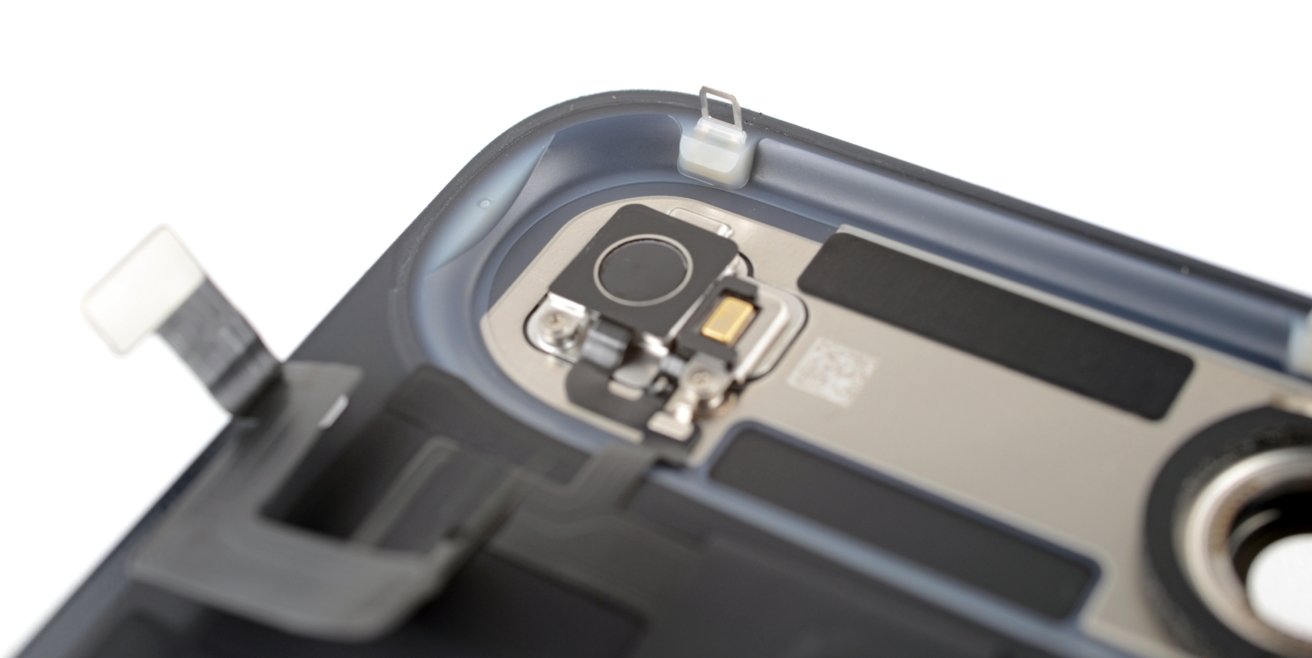
The camera bump in the iPhone Air provides some much-needed space – Image Credit: iFixit
With the logic board removed, the camera assembly was accessible, but after the removal of a tiny flex cable stuck to the camera’s rear.
The logic board was covered in shielding and was split into two layers to show off the chips. The new C1X modem was visible as well as the N1 chip, while the A19 Pro protruded from the board into the plateau.
The screen was then able to be pulled away using a knife, with no damage, albeit with some light scrapes to the titanium frame.
More bendable when empty
While the previous YouTube bend test showed the iPhone Air could take a lot of punishment, it’s a fair bit weaker without any supportive components.
The iFixit bend test failed, but not because of a weakness in the titanium. Really, it was the antenna passthroughs, which introduced plastic elements at the top and bottom of the frame.
The titanium frame is actually three elements, thanks to these passthroughs. While assembled, the weak points were mitigated enough to withstand a lot more weight.
Quite a repairable phone
Breaking down the internals, iFixit says that a large portion of its light weight is from the battery. The power source makes up approximately 28% of the total weight, followed by the titanium chassis, the glass back cover, and the display.
The battery is significantly lower in capacity than in previous years, though it does better than the iPhone 16 due to “software sorcery and hardware optimization.” There is a concern that a smaller battery could result in a higher number of cycles in usage, making it wear out faster.
From the repairability perspective, Apple’s use of a dual-entry system makes repairs easier to perform. Parts pairing is still a concern, and it seems that it is still a process being used, but seemingly with a lighter touch.
Add in Apple’s commitments on spare parts and manuals, and the iPhone Air receives a provisional repairability score of 7 out of 10. That equals the iPhone 16 for ease of repair.
Trending Products

Apple iPhone 12 Mini – Parent...

Apple iPhone SE 2nd Gen – Par...

Apple iPhone 7 32GB Unlocked AT&...

Apple iPhone 14 – Parent (Ren...

Apple iPhone 12 Pro Max, PARENT (Re...

Apple iPhone 8 64GB Unlocked –...

Apple iPhone 15 Plus 5G (512GB, 6GB...

Apple iPhone 14 Pro (Renewed)

Apple iPhone 15 Pro Max – Par...
